
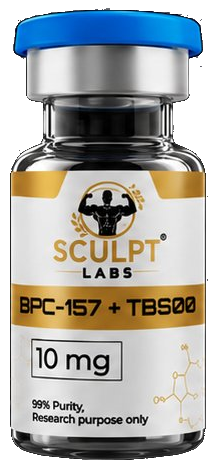
BPC-157 and TB-500 are, by search volume, the two most-looked-up recovery peptides in the UK. This is a research overview of what the published literature reports on each — distinct from any claim about human treatment. Both are supplied for laboratory research only, not for human consumption.
What is BPC-157?
BPC-157 (Body Protection Compound-157) is a synthetic 15-amino-acid peptide derived from a protein found in gastric juice. In preclinical research it is studied for angiogenesis (new blood-vessel formation), fibroblast activity and tendon/ligament and gut-lining repair models.
What is TB-500?
TB-500 is a synthetic fragment of thymosin beta-4, a naturally occurring protein involved in cell migration and actin regulation. Research models examine it for cell migration, blood-vessel formation and tissue-remodelling pathways relevant to recovery.
Why researchers study them together
The two are frequently paired because they appear to act through complementary tissue-repair pathways — BPC-157 more associated with local angiogenesis and connective-tissue models, TB-500 with systemic cell migration. The BPC-157 + TB-500 stack is one of the most common recovery-research pairings discussed in the literature.
The key difference
In simple terms: BPC-157 is studied as the more localised, gut-and-connective-tissue compound, while TB-500 is studied as the more systemic, cell-migration compound. They are researched together precisely because they cover different mechanisms.
Reconstitution basics in a research setting
Both are supplied as lyophilised powders and, for in-vitro work, are reconstituted with bacteriostatic water and stored at 2–8°C. The Sculpt Labs Reconstitution Calculator converts vial mass and diluent volume into mg/mL for record-keeping, and independent HPLC purity data is published on our Purity Reports page.
Frequently asked questions
What is BPC-157?
A synthetic 15-amino-acid peptide derived from a gastric protein, studied in preclinical research for angiogenesis and tendon, ligament and gut-lining repair models.
What is TB-500?
A synthetic fragment of thymosin beta-4, studied for cell migration, blood-vessel formation and tissue-remodelling pathways.
Why are BPC-157 and TB-500 used together?
They appear to act through complementary tissue-repair pathways — BPC-157 more localised, TB-500 more systemic — so they're a common recovery-research pairing.
What's the difference between them?
BPC-157 is studied as the more localised gut/connective-tissue compound; TB-500 as the more systemic cell-migration compound.
How is purity verified?
Independent HPLC analysis from a third-party lab such as Janoshik Analytical confirms identity, purity and batch number, with a COA published per batch.
Sculpt Labs research peptides — HPLC verified, Janoshik tested.
Explore the Sculpt Labs range →⚠ For research purposes only — not for human consumption.