
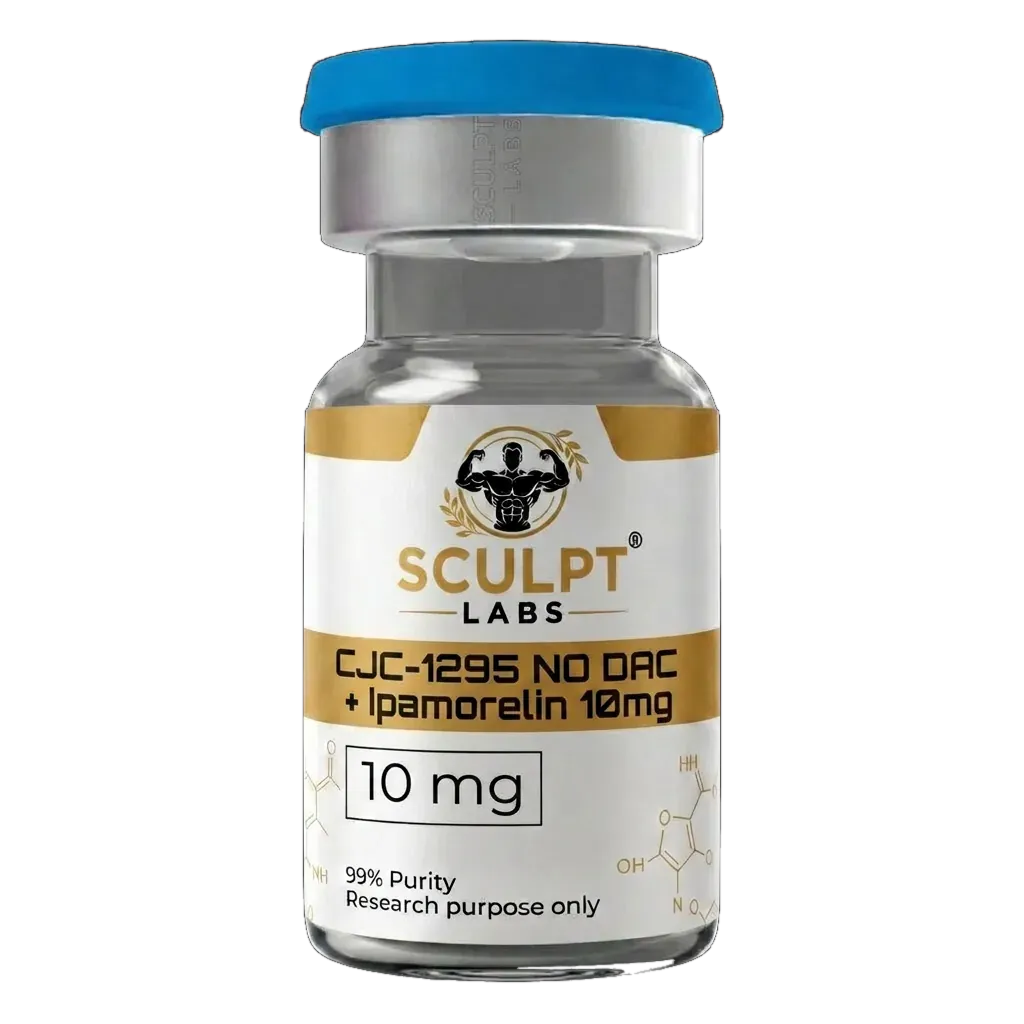
CJC-1295 and Ipamorelin are two of the most-studied growth-hormone secretagogues, and they are frequently researched together as a pre-blended pair. This guide explains why researchers combine a GHRH analogue with a GHRP, what 'no DAC' means, and how the blend is handled in a laboratory setting — distinct from any human-use claim.
What are CJC-1295 and Ipamorelin?
CJC-1295 is a synthetic analogue of growth-hormone-releasing hormone (GHRH), based on the first 29 amino acids of GHRH (the GRF 1-29 fragment). Ipamorelin is a selective growth-hormone-releasing peptide (GHRP) that acts on the ghrelin / GH-secretagogue receptor. They belong to two different receptor classes, which is exactly why they are studied together.
Why combine a GHRH with a GHRP?
GHRH analogues and GHRPs stimulate growth-hormone release through separate, complementary pathways: the GHRH arm increases the amplitude of GH pulses, while the GHRP arm activates the ghrelin-receptor pathway and helps suppress somatostatin (the natural brake on GH release). Research on pairing the two describes a synergistic effect on pulsatile GH secretion greater than either compound alone. Supplying them pre-blended at 5 mg / 5 mg per vial makes single-reconstitution research convenient.
CJC-1295 with vs without DAC
CJC-1295 exists in two forms. The 'with DAC' version adds a Drug Affinity Complex that binds to albumin in the bloodstream, extending its half-life to several days and producing a sustained elevation in research models. The 'no DAC' version — also called Modified GRF 1-29 — has a short half-life of roughly 30 minutes, which produces a more pulsatile profile that more closely mimics natural GHRH rhythm. This blend uses CJC-1295 WITHOUT DAC.
What makes Ipamorelin selective?
Ipamorelin is described in research as one of the most selective GHRPs. Compared with older peptides such as GHRP-6 and GHRP-2, laboratory studies report that Ipamorelin stimulates GH release with minimal effect on cortisol and prolactin, and without the strong hunger signal associated with GHRP-6. That cleaner selectivity profile is why it is a common research pairing partner.
Reconstitution basics in a research setting
The blend is supplied as a lyophilised powder — 5 mg CJC-1295 (no DAC) plus 5 mg Ipamorelin per vial — and is reconstituted with bacteriostatic water for in-vitro work, then stored at 2–8°C. The Sculpt Labs Reconstitution Calculator converts vial mass and diluent volume into mg/mL for record-keeping, and independent HPLC purity data is published for every batch on our Purity Reports page.
Frequently asked questions
What is the difference between CJC-1295 with and without DAC?
The DAC (Drug Affinity Complex) version binds albumin and extends the half-life to several days for a sustained profile; the no-DAC version (Modified GRF 1-29) has a short ~30-minute half-life, giving a more pulsatile profile closer to natural GHRH. This blend uses the no-DAC form.
Why are CJC-1295 and Ipamorelin blended together?
CJC-1295 is a GHRH analogue and Ipamorelin is a selective GHRP. Researchers pair a GHRH with a GHRP because the two act through complementary pathways, and studies describe a synergistic effect on pulsatile growth-hormone release.
What makes Ipamorelin different from other GHRPs?
Ipamorelin is one of the most selective GHRPs — research reports GH release with minimal impact on cortisol and prolactin and without the strong hunger effect of GHRP-6, which is why it is favoured as a research pairing partner.
How is the blend reconstituted?
The lyophilised vial (5 mg CJC-1295 no DAC + 5 mg Ipamorelin) is dissolved in bacteriostatic water for in-vitro work and stored at 2–8°C. Use the Sculpt Labs Reconstitution Calculator to record mg/mL concentration.
Is the blend purity verified?
Yes — independent HPLC analysis from a third-party laboratory such as Janoshik Analytical confirms identity, purity and batch number, with a Certificate of Analysis published for every batch.
Sculpt Labs CJC-1295 + Ipamorelin — HPLC verified, Janoshik tested.
View the HPLC-verified blend →⚠ For research purposes only — not for human consumption.