
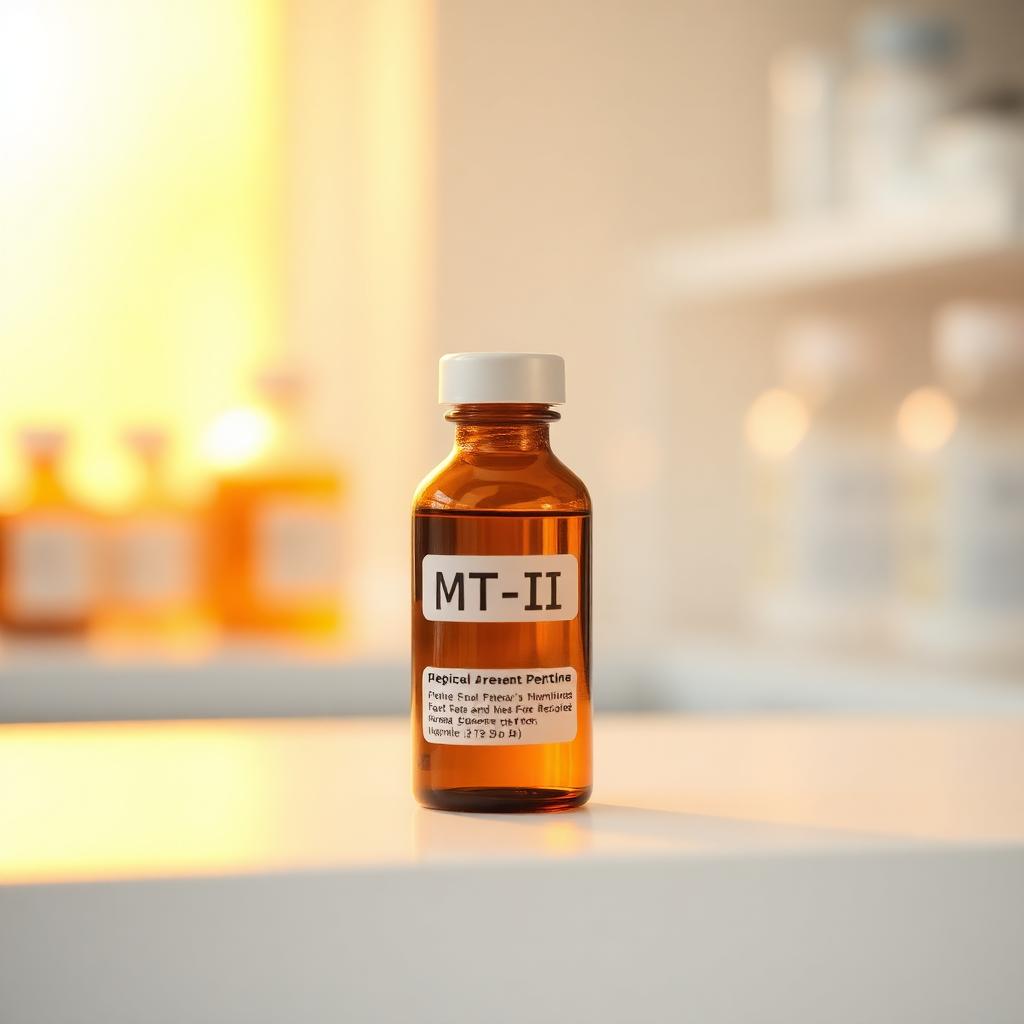
Melanotan II (MT2) is one of the longest-studied α-melanocyte-stimulating hormone (α-MSH) analogues in melanocortin pharmacology. Originally synthesised in the 1980s as part of the University of Arizona melanotropin research programme, it remains a common reference compound in melanogenesis and melanocortin receptor research. This primer summarises the mechanism, the receptor pharmacology and the pathway it activates — written strictly as a research overview.
Origin and structure
Native α-MSH is a 13-amino-acid linear peptide cleaved from pro-opiomelanocortin (POMC). It is potent at melanocortin receptors but degrades rapidly in plasma. MT2 was engineered to address that liability: a shortened seven-residue sequence with substitutions and a cyclic lactam bridge that stabilise the active conformation and extend its in-vitro half-life.
The resulting molecule is a non-selective melanocortin receptor agonist. This contrasts with MT1 (afamelanotide), a linear analogue with greater MC1R selectivity that has a longer published clinical research history in erythropoietic protoporphyria.
The melanocortin receptor family
Five melanocortin receptors (MC1R–MC5R) are recognised in the human genome. They are G-protein-coupled receptors that signal primarily via Gαs and adenylyl cyclase, raising intracellular cAMP. MT2 engages multiple receptors in this family, which is why its reported in-vitro activity is broader than that of α-MSH at any single receptor.
- MC1R — expressed on melanocytes; central to melanogenesis and pigment-type switching.
- MC2R — the ACTH receptor in the adrenal cortex; not a notable MT2 target.
- MC3R / MC4R — hypothalamic receptors involved in energy balance and feeding research.
- MC5R — expressed in exocrine tissues; investigated in sebaceous-gland research.
The melanogenesis pathway in brief
Melanogenesis is the cellular synthesis of melanin pigment within melanosomes inside melanocytes. The canonical pathway proceeds as follows:
- α-MSH (or an analogue such as MT2) binds MC1R on the melanocyte surface.
- Gαs-coupled signalling activates adenylyl cyclase and raises intracellular cAMP.
- cAMP activates protein kinase A, which phosphorylates CREB.
- CREB upregulates MITF, the master transcription factor of melanocyte biology.
- MITF drives expression of tyrosinase, TYRP1 and DCT — the enzymes that convert L-tyrosine through DOPA and dopaquinone into eumelanin and pheomelanin.
Loss-of-function MC1R variants shift the pathway toward pheomelanin (red/yellow pigment) and away from eumelanin (brown/black), which is why MC1R is a well-studied locus in human pigmentation genetics.
Why MT2 is studied in melanogenesis research
As a non-selective, stable α-MSH analogue, MT2 is a useful in-vitro tool for probing melanocortin receptor pharmacology and the MITF–tyrosinase axis. Published research has used it to characterise receptor expression patterns, cAMP responses and downstream gene-expression changes in cultured melanocyte models.
These are mechanistic observations in research systems. They do not constitute clinical evidence and are not a basis for any human-use claim.
Reference-compound considerations
For laboratory work, identity and purity verification are non-negotiable. Reference material should be supplied with independent HPLC purity verification and a batch-specific Certificate of Analysis. Sculpt Labs publishes every Janoshik Analytical batch report on our Purity Reports page, and the Reconstitution Calculator converts vial mass and diluent volume into mg/mL concentration for record-keeping.
Frequently asked questions
What is MT2 (Melanotan II)?
MT2 is a synthetic cyclic heptapeptide analogue of alpha-melanocyte-stimulating hormone (α-MSH). It is a non-selective agonist at several melanocortin receptors (MC1R, MC3R, MC4R, MC5R) and has been used as a reference compound in melanogenesis research.
How does MT2 differ from α-MSH and from MT1 (afamelanotide)?
Native α-MSH is a 13-amino-acid peptide that is rapidly degraded. MT2 is a shortened, cyclic, more stable analogue with non-selective melanocortin activity. MT1 (afamelanotide) is a linear analogue with greater MC1R selectivity and a longer published clinical research history.
What is melanogenesis?
Melanogenesis is the biosynthesis of melanin pigment in melanocytes. It is initiated when α-MSH (or an analogue) binds MC1R, raising intracellular cAMP, activating MITF transcription and increasing expression of tyrosinase, the rate-limiting enzyme converting L-tyrosine into melanin precursors.
Is MT2 approved for human use?
No. MT2 is not approved by the MHRA, FDA or EMA for any indication. It is supplied strictly as a reference compound for in-vitro and laboratory research.
How is research-grade MT2 verified?
Independent HPLC analysis from a third-party laboratory such as Janoshik Analytical confirms identity, purity and batch number. Sculpt Labs publishes COAs for every batch on the Purity Reports page.
Sculpt Labs MT2 (Melanotan II) — HPLC verified, Janoshik tested.
View HPLC-verified MT2 →⚠ For research purposes only — not for human consumption.